
Matthew 16:13-20, Mark 8:27-33, Luke 9:18-22
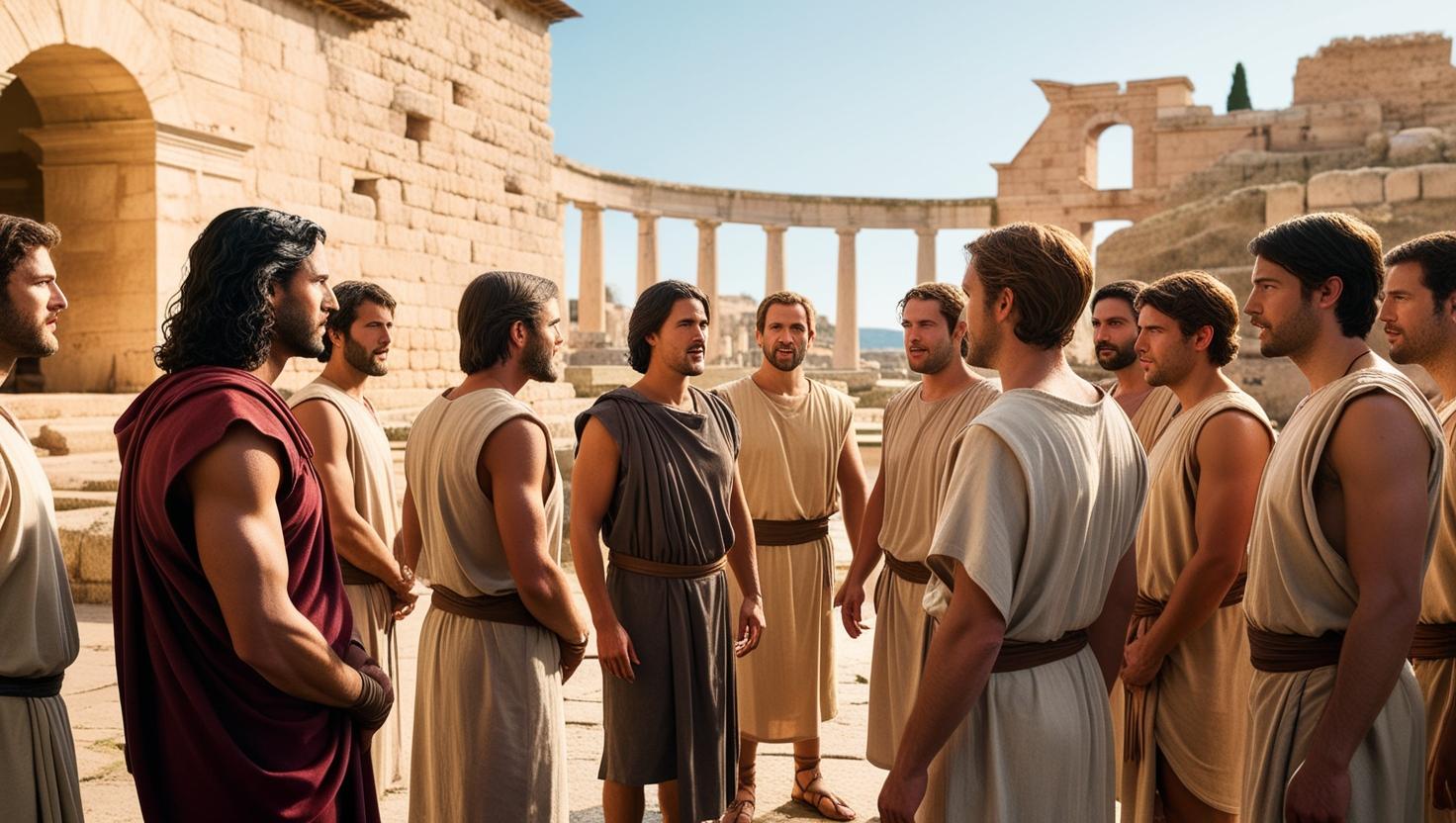
The Lord Jesus took his disciples to visit a place called Caesarea Phillippi, a centre of pagan worship north of Galilee. It was a popular place for people who went there on pilgrimages to worship many different gods. When they were there Jesus asked the disciples what people said about him. There were several answers: some said he was John the Baptist come back to life; others said that Elijah the greatest of all prophets had returned. Then Jesus asked the disciples, “But who do you say I am?”
It was Peter, as spokesman, who replied with what is possibly the most astounding utterance to ever pass human lips: “Thou art the Christ, the Son of the living God.”
In other words, Jesus was no ordinary man at all, not another teacher, preacher, or prophet. He was Christ the promised Messiah. What did Peter mean? He added the most powerful definition possible; “the Son of the living God.” In other words, Jesus was not like the gods worshipped at Caesarea Phillippi; he was and is the Son of the living God, the God who has life and gives life to others, the greatest mystery of all, God incarnate in human flesh.
Jesus responded by saying that this statement could only have been made by divine inspiration and said, “Blessed are you, Simon BarJonah, for flesh and blood has not revealed it to you, but my Father in heaven”. The great gulf between Jesus and all others is highlighted here: one is of earth, the other of heaven.
In this simple statement, Jesus revealed a deep truth. BarJonah means “son of Jonah” and by reverting to the original family name of Simon, meaning “reed”, Jesus drew attention to Peter’s family tree and frail earthly origins and nature.
We know nothing of Peter’s father, whether he was rich or poor, educated or otherwise, and Jesus emphasised that what Peter had said did not come from earthly knowledge and could not have been learnt, passed down, or gained in any other way than through divine revelation. We cannot “become Christians” by being born into a family, or by going to Bible College, learning Scripture, believing certain doctrines, joining a religious order, or becoming a member of a church. It is only by believing and confessing who Jesus is, that God’s divine life is birthed in us, and we become alive by the Spirit of Christ that springs up in permanent residence within us. (Acts 8:37, Romans 10:9)
Jesus asks this question of us all, we have to answer him not with a doctrine or something we have learned from a school, a teacher, a parent, or a spouse. If in response to him, you can say from your heart that he is the Son of God, then you are blessed by God. You have understood the greatest mystery of all, God has a Son and that Son is Jesus; not a mere man but “the Word who became flesh and dwelt among us so that we can behold his glory, the glory of the only begotten of God the Father”. (John 1:12-14).
If in prayer you can say, “Lord I believe you are the Son of the living God” his life comes into you and moves you from the earthly fleshly level into the heavenly divine realm of eternal life. His divine life comes in and you are born again as a new creation, the old life is gone and a new life begins. (2 Corinthians 5:17).
Jesus then said of Peter, “You are Peter and on this rock I will build My church, and the gates of Hades shall not prevail against it.”
Jesus reverted back to the new name that he gave Peter, which means “stone”, and used a play of words to emphasise his mission, for it is on the very statement made by Peter that the entire church is built. Jesus himself is the Rock upon which we stand; nothing else. It points to Jesus, the most perfect and majestic person who has ever walked the planet and who is the image of the Father. He is God the Son, in the flesh yet with the fullness of the Holy Spirit.
If Jesus is not divine, he is nothing. This is the crunch line. We stand upon him the Rock of Ages and nowhere else. Something takes place within us when we take Jesus as our Rock; we become “living stones” upon which the Lord builds his living church. (1 Peter 2:5).
Jesus went further and said that he would give to Peter and his church the keys of the kingdom of heaven. This is a staggering statement: all that Jesus came to establish, the entire kingdom of heaven, he gives to the church! Can we realise the extent of this promise?
Jesus then commanded the disciples NOT to tell anyone at that time who he was and explained to them his soon-coming betrayal, suffering, crucifixion, and death. That was too much for Peter. The man who had just made the most profound statement ever uttered under divine inspiration suddenly became the earthly spokesman for Satan. He took Jesus to one side and gave him a strong verbal rebuke not to speak that way and that suffering such death on the cross must never happen to him.
The response from Jesus was swift and powerful, “Get behind me Satan, you are an offence to me for you are not mindful of the things of God, but things of men.” Having just made the most profound statement Peter still lacked understanding.
How like us is Peter, or should I say how much are we like him? We want the glory but not the cross. Sadly, today, we have Christianity without the Cross. The Gospel is now presented as a means to prosper, a formula for fulfilment, happiness and success. This is what the devil wants: a Gospel without the cross. A church that does not preach the cross is an offence to Jesus.
If we are not willing to bear the cross with Jesus, we have nothing. (Matthew 16:24-28). Dietrich Bonhoeffer, a famous Christian, said, “The cross is laid on every Christian. It begins with the call to abandon the attachments of this world.”
Much later in his life when Peter had seen and experienced the suffering of Jesus he wrote that as living stones we come to Christ who was, for some people, “A stone of stumbling and a rock of offence”. (1 Peter 2:4-8). It is sad that for many people the cross is an offense.
Let us be prepared to carry the cross and build our lives on the Rock of Ages, as living stones in a living temple in which we will dwell with him forever. (Ephesians 2:19-22).
Who do you believe Jesus is? How big is he in your life?
In a few words, what can you learn and apply from this?


You must be logged in to post a comment.