
Matthew 26:34, 74-75, Mark 14:30, 68, 72, Luke 22:60-61, John 13:38, 18:27
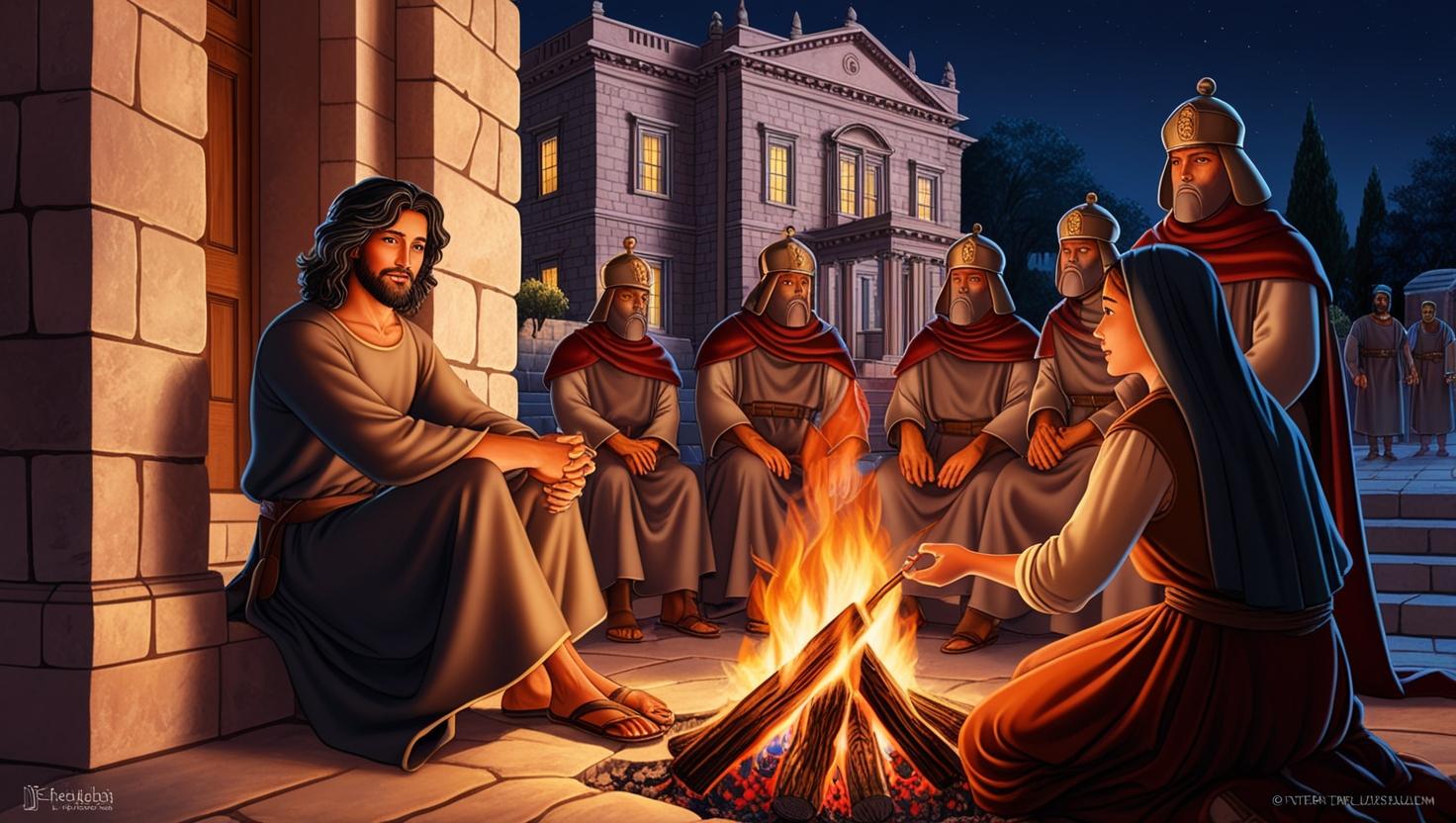
After Jesus was arrested he was taken to the palace of the High Priest for judgment and Peter and “another disciple” followed him there. It is believed this other disciple was John who was able to enter because he knew the High Priest. Once inside he went to the woman who was keeping the door and was able to get Peter to come in also and Peter joined the officers and servants who warmed themselves at a fire. It says “he stood with them” and in another place “he sat down together among them”, in other words, he made as if he were one of them. (John 18:15-18, Luke 22:54-62).
Peter must have seen and heard the trial of Jesus including the false accusations that were made against him as well as the severe beating he suffered.
After a while Peter must have spoken and his accent immediately gave him away as a Galilean and he was challenged by a servant girl for being a follower of Jesus which he denied.
Then one of the guards who arrested Jesus and who was a relative of the man whose ear Peter had cut off recognized him and said he had seen him in the garden. His “cover” now was exposed and Peter reacted by saying he was not a follower of Jesus.
A third person accused him of being a follower of Jesus and this time he began to curse and swear and denied any knowledge of Jesus. (Matthew 26:69-75, Mark 14:66-72).
At that very moment, a rooster crowed and Jesus turned and looked at Peter. (Luke 22:61, John 13:38). Peter Immediately left in a hurry, weeping bitterly.
Why did the look from Jesus have such a devastating effect on Peter?
It was because Peter remembered the Lord had told him that he would betray him three times before the rooster crowed. Peter was overwhelmed with grief when he realised what he had done; far from going to prison and suffering with Jesus, as he had said he would, he failed him dismally. (Luke 22:31-34). That look from Jesus was not one of condemnation but one of compassion. It pierced deep into Peter’s soul exposed the depths of his heart and completely shattered all his preoccupation with himself and revealed his total weakness. It shattered all self-delusion and ego. Peter would never be the same again.
But the Lord had warned him that he would deny him and had also reassured him that He had prayed for him that his faith should not fail. The Lord instructed him that when he was restored he should “care for the lambs”.
For the next few days, Peter had been in great turmoil of mind and distress of spirit wondering whether things could ever come right again. It must have looked extremely bleak for him. We don’t know where Peter spent the next few days but on the third day he was with the “other disciple” who must have been John, the disciple “whom Jesus loved”. (John 20:1-2). John was a loving and caring person with whom Peter felt entirely safe despite his failure.
Suddenly Mary Magdalene burst in with news to tell them that the tomb was empty and these two disciples ran to it. (John 20:3-10). John outran Peter and got there first but Peter arrived and was the first to enter the empty tomb. They saw the napkin neatly folded and the grave cloths, a sign that Jesus had risen, and “they believed”.

The first person to see the risen Lord was a woman, Mary Magdalene, a reformed sinner, and Peter was the first man to enter the empty tomb, the same disciple who had denied him. What an amazing honour for these two people, but neither of them saw the risen Lord at that time.
However, there is something many people miss which is wonderful for we are told that the next person to see the Lord after Mary was in fact, Peter. (Luke 24:34, 1 Corinthians 15:5). Peter was uppermost in the Lord’s thoughts and even the angels told the women to especially inform Peter that Jesus had risen. (Mark 16:7). The Lord found him and appeared especially to him.
Despite Peter’s dismal failure and utter misery, Jesus had not forgotten him and had a private meeting with him, for he was not willing that Peter should spend any more time in a state of distress. We are not told what transpired, but later at Galilee, Peter was again the first to meet the risen Lord when, after a long night fishing in which they failed to catch any fish, he plunged into the lake and swam as fast as he could to the shore to meet Jesus, when he appeared on the lake shore early in the morning. (John 21:3-19).
Peter’s public reconciliation took place in the presence of the other disciples, but his restoration with the Lord had taken place privately before this. What transpired at that first meeting? We will never know, for it was private and personal with no onlookers or hangers-on, but this we do know: Peter was fully forgiven and restored. This is a picture of our future meeting with Jesus, the lover of our souls who, despite our failures and weaknesses, will heal and restore all who believe and trust in him. It is with great expectation that every one of us can look forward to meeting Jesus. He will wipe away the tears from our eyes, and we will see him face to face. (Revelation 7:17, 21:4).
There is a lesson we can all learn from the meeting Jesus had with Peter at Galilee together with the other disciples. Just as Peter had publicly denied Jesus three times so Jesus publicly asked Peter three times if he loved him. Three times Peter answered Jesus that he did love him but he used two different words for love; one was “phileo” and the other was “agape”. One is the natural affection we have for our friends; the other is the deep immeasurable love of God. Jesus used the agape word twice and each time Peter replied with the “phileo” word. Peter then said, “Lord you know all things; you know that I love you”. (John 21:17). He had come to the place where he no longer had to try and impress the Lord but understood that Jesus knew all his weaknesses and failures and still loved him without reserve. Peter was, for the first time, totally secure in the love God had for him.
At this meeting Jesus made a point of addressing Peter as Simon Peter, using his original name of a reed shaking in the wind but combining it with the new name he had given him of Peter, a rock, stable and sure. From this time onwards Peter was seldom called Simon but simply Peter.
Notice each time Peter answered Jesus, Jesus responded by instructing him to “Feed my lambs” (little ones), “Feed my sheep”, and again “Feed my sheep”. (John 21:15-17). Peter went on to be a great apostle but the calling that God gave him first and foremost was to be a shepherd. Many people want to be apostles, prophets, teachers and evangelists but the call of God before any of these is to take care of others who follow Jesus and need love and care. (Luke 22:32).

There is another lesson we can learn from this breakfast on the shores of Galilee. (John 21:18-19). It was when Jesus told Peter that he would die when he was an old man. Tradition records that Peter was killed as a martyr in Rome when he was old.
At first thought, this seems to be a harsh thing for Peter to be told, for from that day, he lived with the knowledge that he would be a martyr. It was a great comfort for him, for from that day on, he knew that he would be kept through all trials and every temptation and be faithful even to his old age. This was why he was not afraid when later he was arrested and faced what seemed to be certain death. He knew they would not kill him at that time. After his denial, Peter had become fully aware of his weaknesses and how easily he could fall, but from then on, he also knew without doubt that God would keep him faithful to become old.
There is another lesson we can learn from the closing moments of the breakfast and that is who the “other disciple” was that Peter asked about. It was John, the beloved disciple. (John 21:20-24). Peter seems to have had a tendency to compare himself to John and had one more question to ask the Lord in response to the words Jesus said concerning the manner of his death. He asked what would happen to John, to which the Lord replied “What is that to you? You follow me”. Peter had to stop comparing himself to others and follow Jesus.
This is an important lesson for us all to learn, which is to not compare or measure ourselves with others. We are all unique, with different personalities, talents, weaknesses and abilities. God can use us all in different ways. We are all to fix our eyes upon Jesus and follow him, not other people, no matter how important they may be.
There will be times of suffering and trial, but glory will come to those who are faithful. One day, Jesus will call all his children together, sons and daughters, disciples and servants. He will prepare a feast for them, and just as he invited the disciples at Galilee to come and have breakfast with him, he will cry, “Come and eat”. (John 21:12). This time, however, it will be at the “marriage feast”. Such rejoicing will take place that no one can imagine, and we will be reunited with loved ones and forever be in the presence of the Lord in the eternal kingdom of God.
Much later, as an old man, Peter wrote his second and final epistle in which he referred to himself as “Simon Peter” having endured much suffering; “I exhort you, I who am a fellow elder and a witness of the sufferings of Christ, and a partaker of the glory to be revealed: shepherd the flock of God”, “may the God of all grace, who called us to His eternal glory by Jesus Christ, after you have suffered a while, perfect, establish, strengthen, and settle you. To him be glory and dominion forever and ever. Amen.” (1 Peter 5:1, 10-11).
See how many lessons you can learn from the way that Jesus appeared to Peter and his disciples after his resurrection.
Try and imagine what it will be like to see the risen Lord in his glory.



You must be logged in to post a comment.