
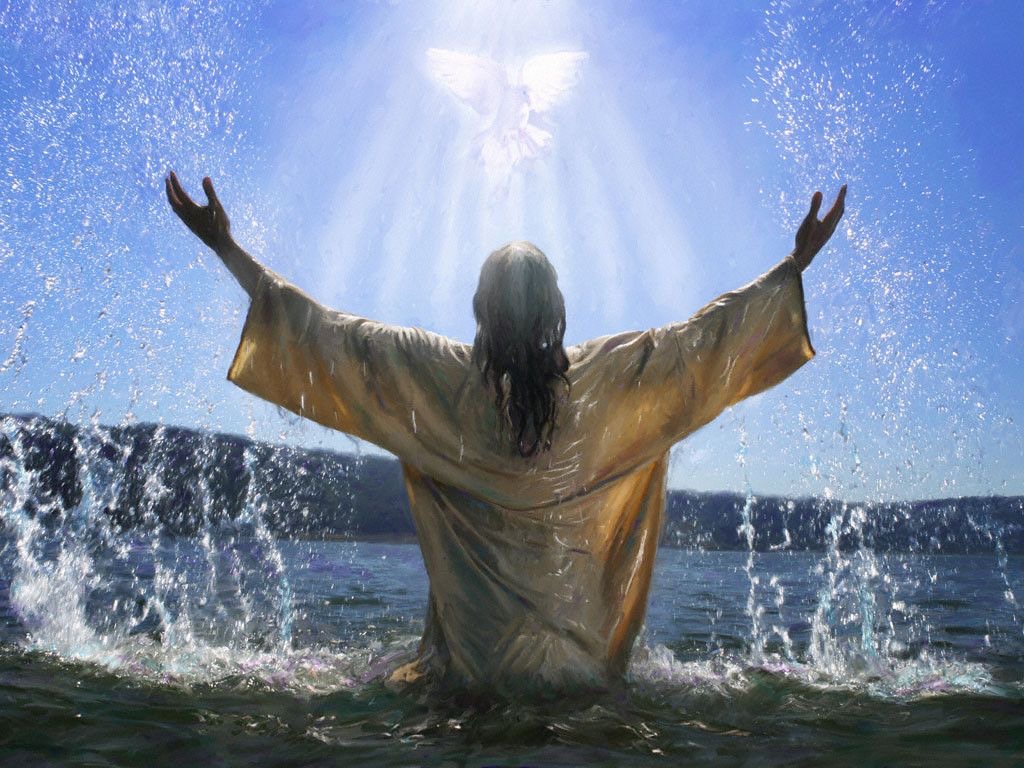
The First is the Baptism of Repentance.:
To receive Christ sinners must first repent. This is a spiritual necessity for all who would receive Christ. In the days of John the Baptist this was expressed in baptism but it must first be an inward experience. We all must repent of sin.
The Second Baptism is to be Baptised into Death:
We must turn from the “dead works”, which are our own self-efforts for salvation, and die to ourselves and be buried with Christ. The sinner personally identifies with the death of Christ. (Romans 6:3, Galatians 2:20, Colossians 2:11-15).
We are baptised into death, but not any death, but “death to sin and self”. Water baptism depicts this by the believer being symbolically buried in immersion and then rising in Christ’s new life. We die and rise with Christ. (Romans 6:1-14). Christ cancelled the law written against us and set us free. Just as a dead person can no longer die or break any laws, so too we are set free from sin and the law being dead to them. We have been delivered from sin and death. We are no longer “under the law of sin and death” or held in its power, and we are now enabled to live life in the Spirit of Jesus Christ. (Romans 8:1-14).
Water baptism is a declaration of our turning away from a life of sin and self and trusting wholly in what Christ has done. His grace becomes the means to set us free from the old life of sin. We are no longer “under law but under grace”. This does not mean, as some may think, that we are free to continue living in a sinful way, but having died to the old life and the person we used to be, we now live a totally new life free from sin, not free in sin.
The Third Baptism is the Baptism into Christ:
As already explained, we become one with him. (1 Corinthians 6:17). Christ lives in us, and we live in him. (Galatians 2:19-20). The apostle Paul wrote that “for me to live is Christ and to die is gain”. (Philippians 1:21). It is Christ in you that is the hope of glory. (Colossians 1:27). Because he lives in us by his Spirit, we now have the life of Christ in us, and the Spirit of Christ resides in us. (Romans 8:9-10). One of the proofs of rebirth is a change in lifestyle.
The Fourth Baptism is into the Holy Spirit:
When Christ comes in, we are reborn and become a new creation. Once he lives in us by his Spirit, he wants us to live in his Spirit. This is the baptism into the third member of the Godhead, the Holy Spirit. It is seen by some as distinct from one’s initial rebirth. I have seen new converts immediately filled with the Holy Spirit after being baptised in water, and I have known others who only experienced this baptism many years after their conversion. Much depends on one’s understanding, but I have noticed that those who are obedient in full water baptism also experience this baptism quicker than others.
Baptism into Christ gives us spiritual life, whereas baptism in the Holy Spirit gives us the ability to serve him. (Matthew 3:11, Acts 1:5, 8:12-17). The baptism into the third member of the Godhead is possible through the work of Christ. After a person receives Christ, the Holy Spirit becomes their comforter and teacher. He directs and moulds them, changing them into the image of Christ. The Holy Spirit strengthens and nurtures the new Christ-life. In this way, the believer is empowered by the Spirit to serve Christ.
There are nine fruits of Christ’s Spirit, and there are nine gifts of the Holy Spirit. (Galatians 5:22-26, 1 Corinthians 12:7-10):
The fruits of the Spirit are listed in three groups:
- Love, Joy, and Peace are to enjoy
- Patience, Kindness and Goodness are to help us relate to others
- Faithfulness, Gentleness and Self-Control are for inner strength
The gifts of the Spirit are given in three groups:
- Wisdom, Knowledge and Discerning of spirits, all necessary for leadership
- Faith, Healing and Miracles, required for helping others
- Prophecy, Tongues and Interpretation of Tongues, and the Vocal gifts for encouragement and edification
Jesus makes it possible for the Holy Spirit to live in us. Our body becomes the temple of the Holy Spirit. (1 Corinthians 6:15-20).
The extent to which we allow Christ to fully possess us is the extent to which we attain the fullness of his Spirit, and his fullness is to be continually renewed. There is an ever-developing and continual growth in the life of Christ, and these baptisms are interconnected.
The Fifth Baptism is into the Body of Christ:
The Ecclesia or Church – at conversion, the new believer becomes a member of the spiritual church of Jesus Christ. This church is not a denomination but the corporate spiritual “body of Christ”. One cannot become a member of this church by registering on a church membership roll but by being baptised into Christ, and water baptism is the recognised Biblical manner in which one declares one’s allegiance to the church of Jesus. The word ecclesia means “chosen or called out ones” – all those who believe in and actively follow Jesus.
It is the “body of Christ” on earth and comprised of young and old, male and female, Gentile and Jew, who have all been born again. It is a visible manifestation of the invisible Kingdom of God on earth. It is not the Kingdom but should reflect and declare it.
The aim of the Lord is to take converts and integrate them into the spiritual body where they can grow and function, find encouragement and support, and contribute in service and mutual love and care of each other. (Romans 12:5, 1 Corinthians 12:12-27, Galatians 3:26-27, Ephesians 1:22-23, 4:4, 25, Philippians 1:27).
God places in this fellowship of believers ministry gifts, and we will consider them later. (1 Corinthians 12:28-31).
The Sixth Baptism is into Suffering:
To belong to Christ’s Kingdom is to be an alien on earth and an obstacle to the kingdom of darkness. The citizens of God’s Kingdom have a different worldview from that of the world, and this may bring about persecution. We have already considered this as expressed by Jesus in his teaching, known as the Beatitudes. The kingdoms of darkness are controlled by the devil. Many believers in numerous countries experience persecution. As we identify with each other in suffering, the church grows in maturity and blessing.
Trials produce perseverance. (Luke 12:50, Mark 10:37, John 15:18, 2 Timothy 3:12). We don’t want this baptism, but it is a reality.
The Seventh Baptism is into the Father and His Love
I believe that there is a seventh baptism and although this may not be immediately apparent, I believe it is nevertheless very special. It is to know God the Father in an intimate relationship.
As we have seen, the word baptism means to be identified with and joined to something, to be put in or made one with it. The prayer of Jesus in John 17 reveals his desire that we be one in him just as he is one in God the Father.
The Almighty God, Father, Son and Holy Spirit, is three persons in one. Jesus prayed for believers to be one in him and in the Father. (John 17:11, 21-23). This is to be in perfect oneness with God and is what Jesus wants his followers to experience: to be one in the Father, the Son and the Spirit. I believe this happens in a baptism into the Father and his divine nature. Like all the other baptisms, it is an ongoing experience in which we grow to know God as Father.
Join me as we continue on our journey through “A Life of Faith.”
Blog series Five – Principles for Life in Christ:
Episode 5: Baptism into the Father and His Love
Episode 6: Laying on of Hands
Episode 7: Resurrection of the Dead
Episode 8: Judgement, Eternal Judgement
Episode 9: Growing Up in Christ


You must be logged in to post a comment.