
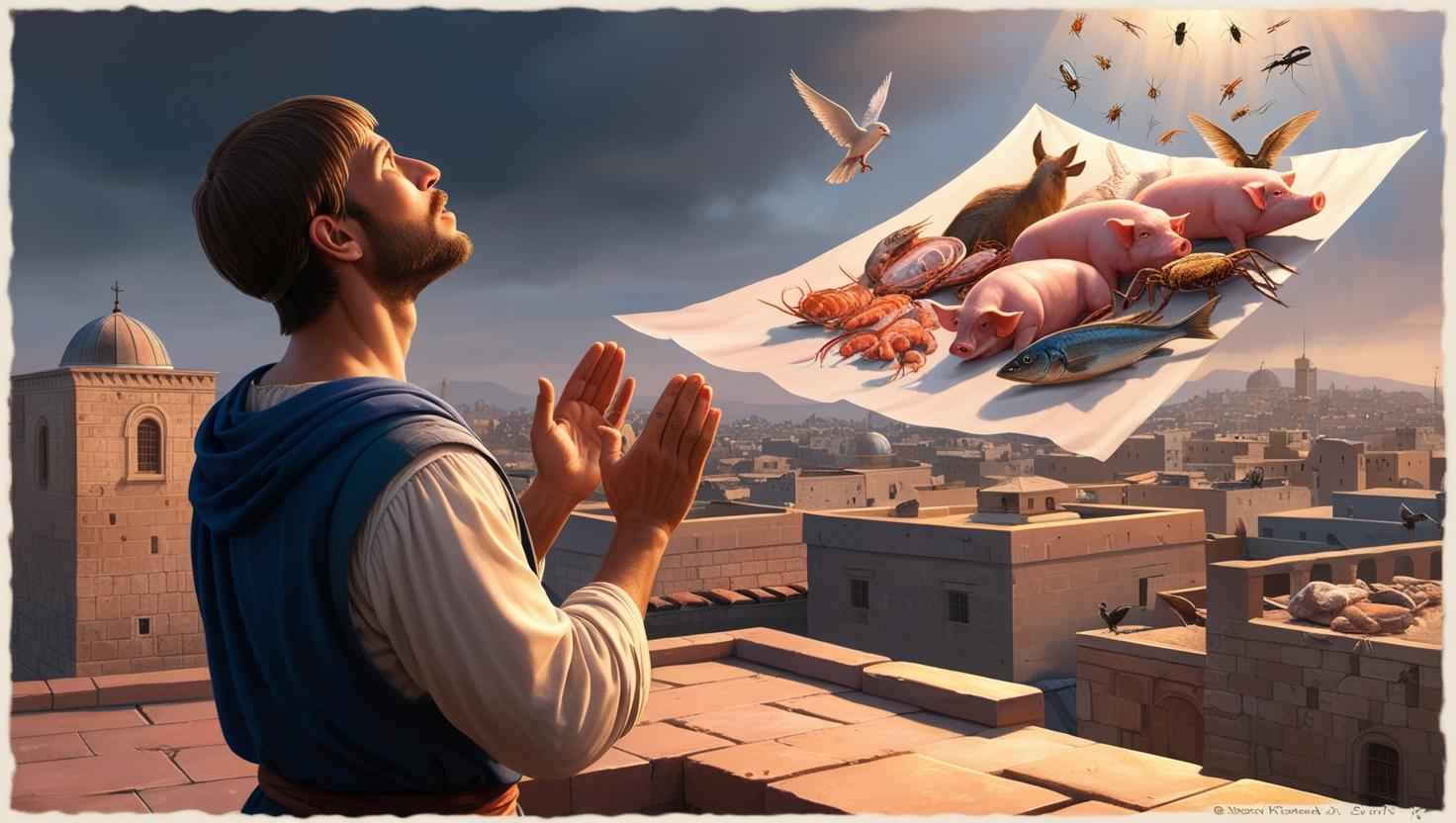
PETER LEARNS A LESSON
Acts 10:9-16
Peter was the apostle sent to the Jews, whereas Paul was the apostle sent to the Gentiles. Peter was a strong witness for God in Jerusalem, and in his early years, he mixed primarily with Jews. He had an attitude towards those who were not Jewish and did not keep the Jewish way of life, and the Lord had to deal with him in a remarkable way to break this.
One day, he was in prayer on the rooftop of the house where he was staying. Houses of that time often had open flat roofs, which were used as an upper extension to the living area. While in prayer, Peter had an unusual vision. (Acts 10:9-16). He saw a sheet let down from heaven that held every kind of food, including foods that were listed in the Old Testament as being unclean and, therefore, forbidden for him to eat. In the vision, Peter was instructed to rise and eat, but as a Jew, he refused to do so, saying that he would not eat that which was unclean. Then he was told, “What God has cleansed you must not call common”. This was said to him three times.
At that very moment, three messengers arrived to ask him to go quickly with them to a family in Caesarea. Peter was, at first, very judgmental and hesitant to go as they were not Jewish people but Gentiles, but when he obeyed and went with them, a great miracle took place for their family and close friends, who all believed the Good News that Peter brought and who received Jesus as Lord and were filled with the Holy Spirit. This was an event on par with the first coming of the Holy Spirit on the Day of Pentecost to the Jews, but this time it was to the Gentiles. Peter, as a Jew, was amazed.
God called Peter to Shepherd his people and he had to learn this lesson to be used by the Lord. Peter had confined his preaching only to Jews for he was steeped in Jewish customs, values and rituals. However, Jesus had said that he had “other sheep” that were lost and that they too must come to him so that they could all become one flock in one fold. (John 10:16). Peter had a serious cultural and racial prejudice against people non-Jewish and unless the Lord dealt with him he would have restricted the good news of the Gospel only to Jews.
God is able to speak to us in many ways in order to guide us and make his will known to us. The vital thing we need to do is to pray. Peter had gone up onto the roof of the house in order to pray. He was a man of daily prayer and made it a habit to seek the Lord’s face. It was during prayer that Peter came to hear, see, and understand God’s will. When the men from Joppa came, he was fully prepared to meet them and to go with them.
God still shows his will to those who seek him in prayer. Don’t give up, ask and seek expectantly. There are many ways that God can speak to us, through dreams, visions, and spiritual impressions, as well as inner convictions and the Word of God itself. Just as the Lord confirmed his will three times to Peter, so he confirms his guidance to us through other ways, often through fellow believers. For Peter, the confirmation came almost immediately when three messengers arrived and explained why they had come. Then, all became clear to Peter. God doesn’t expect us to trust only in ourselves but to always seek his will.
Seek the Lord for every need you have and wait upon him for direction and confirmation. God is seldom in a hurry, he usually prepares us in some way for what he wants us to do.
Even after this direction Peter still struggled to accommodate Gentiles and several years later we see that he and Paul had a disagreement. Peter was the apostle God used primarily to the Jews but Paul was the apostle God chose to take the Gospel to the Gentiles. There was a dispute about how Gentiles should serve the Lord and some wanted them to become like Jews and keep the Jewish laws and customs.
Paul challenged Peter during a Council held in Jerusalem that was called by leaders to decide what to do about this disagreement. This was very difficult for Peter, who, as the recognised apostle to the Jews, would have identified with the Jewish ways. Nevertheless, he submitted to the leadership of Paul and many years later wrote some of his final words in recognition of his teaching. (2 Peter 3:15-16). Peter had lost all his self-importance and was a humble man who God used to win others.
He proved true to Jesus and never allowed disagreement to reign. He was a true shepherd who won all people to the Lord. Many, if not most, of us have to learn this lesson at one time or another in our walk with Jesus. We are not to judge others by our own likes and dislikes or reject others because they are not of our race or culture. God loves all people, and the Gospel is not restricted to any one cultural, race, or national group.
Think about times in which the Lord has helped you in the past and how he will be able to direct you in the future.




You must be logged in to post a comment.